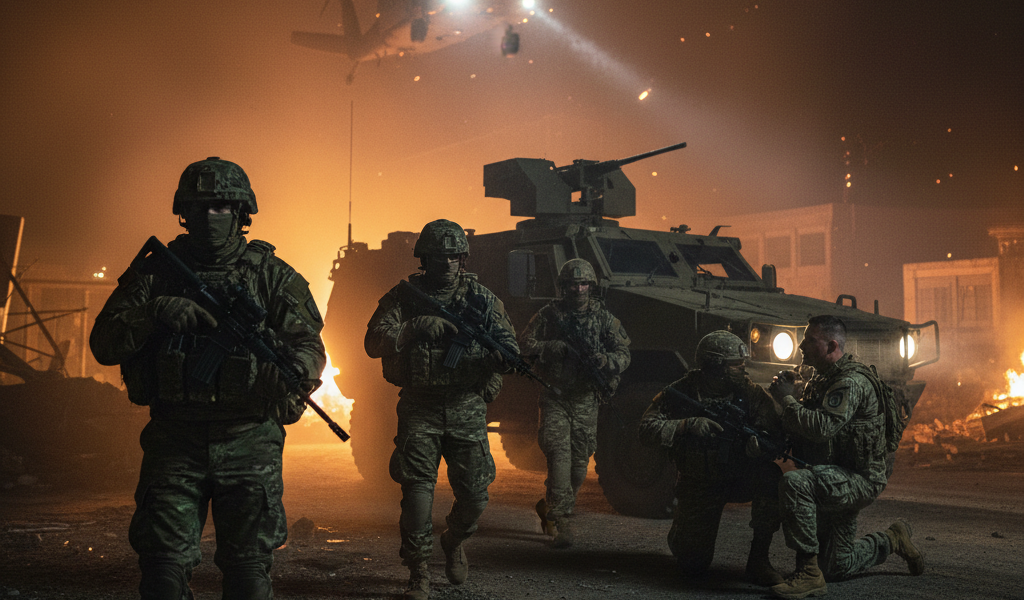
The strategic landscape of American defense and domestic security witnessed a significant confluence of policy announcements and operational highlights this week, underscored by a high-profile visit by President Donald J. Trump and Secretary of War Pete Hegseth to Memphis, Tennessee. The joint appearance served as a powerful platform to spotlight the demonstrated effectiveness of a National Guard-led anti-crime task force, while simultaneously unveiling crucial initiatives aimed at bolstering the welfare of Guardsmen and modernizing the venerable Military Chaplain Corps. These developments collectively signal a robust commitment to enhancing national security from both external and internal threats, redefining the operational parameters of the Guard, and ensuring the holistic well-being of the Total Force.
The presidential delegation’s presence in Memphis cast a national spotlight on a localized yet profoundly significant operational model: the deployment of National Guard assets in direct support of civil authorities to combat violent crime. This particular task force, designed to augment the capabilities of local law enforcement agencies, has demonstrated quantifiable success in reducing crime rates and restoring a sense of security within targeted urban areas. The Secretary of War emphasized the innovative application of military planning, intelligence fusion, and logistical support to a domestic challenge traditionally perceived as solely within the purview of civilian police forces. This integration, he noted, leverages the unique skill sets and disciplined approach of military personnel, providing a force multiplier in complex urban environments. The Guard’s involvement extends beyond mere patrol presence; it encompasses sophisticated data analysis, targeted interdiction operations against gang violence and illicit narcotics trafficking, and critical infrastructure protection. The operational framework is meticulously designed to ensure strict adherence to the Posse Comitatus Act, operating under Title 32 orders that maintain the Guard’s state active duty status while receiving federal funding and oversight, thus preserving the delicate balance between military support and civilian law enforcement primacy.
Historically, the National Guard has served as the nation’s primary reserve combat force, simultaneously acting as a first responder to domestic emergencies ranging from natural disasters to civil unrest. Its dual mission, enshrined since the Militia Act of 1903, positions it uniquely at the nexus of national defense and homeland security. However, the post-9/11 era fundamentally reshaped the Guard’s operational tempo and scope. Deployments to combat zones became routine, transforming many units into seasoned veterans of protracted conflicts abroad. Concurrently, the increasing complexity of domestic threats, from sophisticated cyberattacks to widespread civil disturbances and persistent urban crime, has led to a reevaluation of the Guard’s potential utility on the home front. The Memphis initiative represents a deliberate strategic pivot, demonstrating a willingness to employ the Guard’s capabilities more proactively in enduring domestic security challenges. This approach, while effective, prompts critical discussions regarding the potential militarization of domestic law enforcement, the preservation of civil liberties, and the appropriate boundaries of military engagement in civilian affairs. Military analysts contend that the Guard’s structured command and control, rigorous training, and access to advanced technology, when carefully integrated and overseen, can provide an invaluable resource without overstepping constitutional bounds. The emphasis remains on providing support functions—intelligence, logistics, specialized equipment, and personnel for specific, targeted operations—rather than supplanting civilian police authority.
Beyond the immediate operational success in Memphis, the administration announced a comprehensive package of expanded benefits for National Guardsmen, a move long advocated by military associations and a critical component of the Total Force Policy. The citizen-soldier, once primarily a weekend warrior, has evolved into an indispensable component of the nation’s defense apparatus, enduring multiple deployments, extended periods away from civilian employment, and significant personal sacrifices. Yet, the benefits structure for Guardsmen has historically lagged behind that of their active-duty counterparts, creating disparities in healthcare access, educational entitlements, and retirement security. The newly unveiled benefits package seeks to rectify many of these inequities, recognizing the increasing operational demands placed upon the Guard. Key provisions are understood to include enhanced healthcare coverage, potentially extending Tricare eligibility to Guardsmen and their families for longer periods post-deployment or even during periods of non-active duty. Education benefits, such as expanded tuition assistance and GI Bill eligibility, are also being addressed to better support Guardsmen pursuing higher education or vocational training, recognizing the critical role education plays in both their civilian careers and military readiness. Furthermore, improvements to housing allowances and family support programs are anticipated, designed to alleviate financial burdens and enhance the overall quality of life for Guard families, who often bear the brunt of frequent and unpredictable deployments.
The rationale behind these expanded benefits is multifaceted. From a strategic perspective, it is a critical investment in recruitment and retention. A robust and well-supported Guard force is essential for national security, providing the strategic depth and surge capacity required to respond to unforeseen contingencies, both at home and abroad. High operational tempo coupled with inadequate benefits has historically led to attrition, impacting readiness and institutional knowledge. By enhancing benefits, the Department of Defense aims to make service in the National Guard a more attractive and sustainable career path, ensuring a consistent influx of qualified personnel and retaining experienced leaders. Moreover, it is a matter of equity and recognition. Guardsmen deploy alongside active-duty service members, face the same dangers, and endure similar separations from family and civilian life. To deny them comparable benefits undermines morale and the very concept of a unified Total Force. The historical evolution of Guard benefits reflects a slow but steady recognition of their increasing integration into the operational military. From the limited support of the early 20th century to the significant enhancements post-Vietnam and especially post-9/11, each step has been a response to the Guard’s heightened operational role. This latest expansion marks a pivotal moment, signaling a federal commitment to treating the Guard as a full and equal partner in national defense, not merely a supplemental force.
Concurrent with these developments, Secretary Hegseth announced significant reforms to the Military Chaplain Corps, an institution vital for the spiritual, moral, and ethical well-being of service members across all branches. The Chaplain Corps, with a lineage tracing back to the Revolutionary War, has consistently provided religious support, counseling, and moral guidance to troops in every conflict the nation has faced. Its mission is to nurture the spiritual resilience of service members, ensure the free exercise of religion, and provide ethical leadership within the unit. However, the modern military presents a complex and evolving spiritual landscape. The diversity of faiths and belief systems within the ranks, coupled with the increasing prevalence of mental health challenges and the moral complexities of contemporary warfare, necessitates a dynamic and adaptive Chaplain Corps. The announced reforms are understood to address several critical areas: enhanced training, expanded scope of services, and a renewed emphasis on mental health integration.
The reforms are expected to place a greater emphasis on interfaith competency and cultural sensitivity in chaplain training. With service members representing a multitude of religious and non-religious worldviews, chaplains must be equipped to provide spiritual care that respects and understands this diversity, facilitating religious accommodation while also serving as a unifying force. This includes training in world religions, secular humanism, and ethical decision-making in morally ambiguous situations. Furthermore, the scope of chaplain services is likely to expand, moving beyond traditional pastoral care to include more robust programs for suicide prevention, combat stress management, and moral injury recovery. Chaplains often serve as the first line of defense for service members struggling with psychological or ethical dilemmas, given their accessibility and the confidential nature of their interactions. Integrating them more deeply into comprehensive soldier fitness programs, working in concert with mental health professionals, will amplify their impact on overall troop readiness and well-being. Historically, the Chaplain Corps has adapted to changing military needs, from battlefield ministries in the World Wars to crisis counseling in Vietnam and the spiritual demands of protracted counterinsurgency operations. These latest reforms reflect a proactive effort to equip chaplains for the unique challenges of the 21st-century force, ensuring they remain relevant and effective in fostering spiritual readiness, which is recognized as a critical component of overall resilience. The reforms also aim to address recruitment challenges, ensuring the corps attracts and retains chaplains from a broad spectrum of faith traditions, capable of ministering to a diverse force.
The convergence of these three distinct yet interconnected initiatives—the deployment of the National Guard for domestic security, the expansion of benefits for Guardsmen, and the reform of the Chaplain Corps—paints a clear picture of the administration’s strategic priorities. It underscores a comprehensive approach to national security that recognizes the critical interplay between external defense and internal stability. The Memphis initiative highlights a willingness to leverage military capabilities, particularly those of the highly adaptable National Guard, to address pressing domestic challenges, albeit with careful consideration of civil-military boundaries. The enhanced benefits package represents a vital investment in the human capital of the Total Force, acknowledging the profound sacrifices of citizen-soldiers and reinforcing the principle of equitable support. Finally, the reforms to the Chaplain Corps underscore a commitment to the holistic well-being of service members, recognizing that spiritual and moral resilience are as crucial to combat effectiveness as physical and mental fitness. These initiatives collectively aim to forge a more robust, resilient, and ethically grounded military, capable of meeting the diverse and evolving threats of the contemporary era, both on the battlefield and within the nation’s borders. The implications are profound, signaling a recalibration of military-civilian relations, an elevated status for the reserve components, and a deepened commitment to the comprehensive care of all who wear the uniform.
More From Breaking News
 Breaking News
Transatlantic Defense Media Expands European Footprint Amidst Resurgent Geopolitical Tensions
 Breaking News
F-35 Lightning IIs Decimate Houthi Missile Infrastructure in Red Sea Retaliation Strikes
 Breaking News
Ukraine Navigates Dual Crises as Deepening Iran War Drains Western Air Defenses Amid Russia's Persistent Offensive
 Breaking News