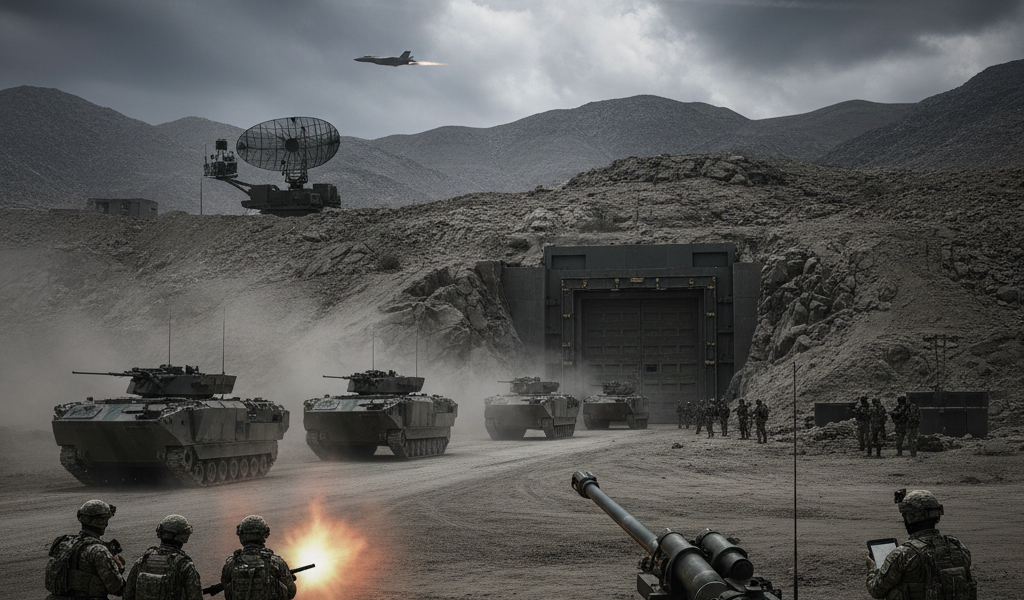
The concept of a fortified, subterranean command and control complex beneath the nation’s highest civilian leadership has long been a cornerstone of strategic defense planning, evolving with each new threat vector. Recently, discussions around the potential development of a massive military installation beneath the White House ballroom have brought this critical aspect of national security into sharp focus. Such a project, if undertaken, would represent a significant investment in the continuity of government (COG) and the resilience of the national command authority, reflecting a contemporary understanding of the multifaceted threats confronting the United States. This endeavor is not merely about constructing a physical shelter; it is about embedding strategic depth and survivability into the very heart of the American executive apparatus, ensuring unhindered decision-making capabilities even under the most extreme duress.
The proposed initiative, described as a “massive military complex” shielded by a new White House ballroom, points to a sophisticated approach to operational security (OPSEC) and hardened infrastructure. The strategic placement beneath an ostensibly civilian structure suggests a dual-purpose design: providing a robust, survivable environment for critical military and governmental functions while simultaneously masking its true nature and scale from external observation and potential adversaries. This layered defense philosophy, integrating overt civilian infrastructure with covert military capabilities, is a testament to the evolving nature of strategic competition, where deception and resilience are paramount.
Historically, the United States has invested heavily in subterranean facilities designed to safeguard national leadership and critical command elements. The Cold War era, characterized by the omnipresent threat of nuclear annihilation, spurred the creation of iconic hardened sites such as the Cheyenne Mountain Complex in Colorado, Mount Weather in Virginia, and Raven Rock Mountain Complex (Site R) on the Pennsylvania-Maryland border. These facilities were engineered to withstand direct nuclear strikes, providing secure havens for the Joint Chiefs of Staff, the National Command Authority, and various civilian agencies. Their existence underscored a fundamental principle: the ability to command and control military forces and maintain governmental functions during a catastrophic event was non-negotiable for national survival. These complexes were not merely bunkers; they were self-contained cities, equipped with independent power generation, water purification, air filtration systems, extensive communications arrays, and living quarters, designed for prolonged isolation.
The strategic rationale behind these Cold War-era facilities remains largely relevant today, though the threat landscape has diversified considerably. While the specter of peer-on-peer nuclear exchange persists, the contemporary environment also encompasses sophisticated cyber warfare, advanced conventional weapons, hypersonic missile technology, space-based threats, and the enduring challenge of global terrorism and weapons of mass destruction (WMD). A modern subterranean complex beneath the White House would, therefore, need to address a broader spectrum of threats, integrating cutting-edge defensive technologies with traditional hardening techniques.
A “massive military complex” implies a multi-functional facility far beyond a simple bunker. It would likely house a secure, redundant command and control (C2) center, equipped with state-of-the-art communications infrastructure capable of linking directly to the Pentagon, Strategic Command (STRATCOM), and other critical operational nodes worldwide. This C2 capability would be paramount for coordinating national defense, intelligence gathering, and crisis response during any major contingency. Furthermore, such a complex would need to accommodate key presidential staff, military advisors, intelligence personnel, and perhaps even elements of the National Security Council, ensuring that the President can receive real-time intelligence, conduct secure consultations, and issue directives without interruption.
The strategic location beneath the White House offers distinct advantages. Proximity to the President is critical for immediate access and secure communication, reducing transit times and exposure during a crisis. The inherent security posture of the White House complex, already one of the most protected sites globally, would provide an initial layer of defense. However, the existing White House facilities, while robust, were not designed for the extreme resilience required against modern strategic threats like direct kinetic attacks, electromagnetic pulse (EMP) events, or sophisticated cyber penetrations aimed at disrupting critical infrastructure. A purpose-built subterranean complex would offer a level of hardening and isolation that current above-ground structures cannot provide.
Engineering and construction challenges for such an undertaking would be monumental. Excavating a “massive” complex beneath an existing, historic structure in a densely populated urban environment like Washington D.C. presents unparalleled logistical, geotechnical, and security hurdles. The sheer volume of material to be excavated, transported, and disposed of would require extensive planning and execution, all while maintaining the utmost secrecy and minimizing disruption to the surrounding area. Geotechnical surveys would be critical to understand the underlying geology, groundwater levels, and potential impacts on nearby structures. The construction process itself would need to be highly secure, employing specialized techniques to prevent espionage, sabotage, and unauthorized observation. This would likely involve advanced tunneling technologies, vibration-dampening measures, and continuous monitoring.
The cost associated with such a project would undoubtedly run into billions of dollars, making it one of the most expensive infrastructure projects ever undertaken by the U.S. government. However, from a strategic perspective, the investment would be framed as an essential premium on national security and the preservation of the constitutional order. The timeline for completion would also be extensive, spanning many years, if not a decade or more, given the complexity and scale. During this period, interim measures and existing COG facilities would continue to serve as the primary safeguards.
The “ballroom shield” concept is particularly intriguing from an OPSEC standpoint. By constructing a new, visible ballroom above ground, attention is drawn to an architectural enhancement, subtly diverting scrutiny from the covert subterranean activities. This form of strategic deception, common in military engineering, serves to maintain a veil of secrecy around the true purpose and scale of the underground facility. It complicates adversary intelligence gathering, making it harder to accurately assess the complex’s capabilities, vulnerabilities, and precise location. In an era where satellite imagery and advanced sensor technologies provide unprecedented transparency, such architectural camouflage becomes a vital component of defense.
Beyond physical hardening, a modern subterranean complex must incorporate advanced technological defenses. EMP hardening would be essential to protect electronic systems from the catastrophic effects of a high-altitude nuclear detonation or a directed energy weapon. Sophisticated air filtration systems would be required to guard against chemical, biological, radiological, and nuclear (CBRN) contaminants. Independent power generation, potentially including micro-reactors or extensive battery arrays, would ensure continuous operation irrespective of external grid failures. Redundant and diversified communication links, utilizing fiber optics, satellite uplinks, and secure radio frequencies, would guarantee connectivity even if primary channels are disrupted.
The concept of a centralized, hardened command node, while offering significant advantages in terms of consolidation and immediate access, also invites strategic debate. Some defense strategists argue for a more distributed approach to COG, spreading critical functions across multiple, geographically dispersed facilities to prevent a single successful attack from decapitating national leadership. However, the White House complex serves a unique symbolic and functional role as the nexus of executive power. A hardened facility directly beneath it ensures that the President can remain physically present in the seat of power, even during extreme events, projecting stability and resolve to both domestic and international audiences. This psychological aspect of leadership continuity cannot be underestimated in a crisis.
When considering expert commentary on such proposals, military strategists consistently emphasize the dual requirements of survivability and functionality. General (Ret.) James Mattis, for instance, often spoke of the need for resilient C2 that can “fight through” disruption. A subterranean complex would be designed to provide that resilience, allowing the President and the command element to continue executing their duties without degradation. Civil engineers specializing in hardened structures would highlight the complexities of underground construction, particularly in urban environments with existing infrastructure and sensitive historical sites. National security analysts would likely weigh the strategic benefits against the immense costs, examining whether such an investment yields a proportional increase in national security against the most probable threat scenarios.
Comparing this potential U.S. initiative to those of other major powers reveals a shared strategic imperative. Russia, for example, is widely believed to possess an extensive network of deep underground facilities, including the fabled “Metro-2” beneath Moscow, designed to protect its leadership and ensure command continuity. China has likewise invested heavily in subterranean military and government complexes, reflecting a similar understanding of the need for strategic depth and resilience against advanced conventional and nuclear threats. These global parallels underscore that the proposed White House complex is not an anomaly but rather a contemporary manifestation of a long-standing strategic doctrine adopted by leading nations.
The implications of constructing a massive military complex beneath the White House are profound. It signals a heightened awareness of evolving global threats and a proactive commitment to hardening the core of American executive power. Such a project would reinforce the nation’s COG capabilities, ensuring that the mechanisms of governance and national defense remain robust and operational under any circumstances. It would project an image of unwavering resolve to adversaries, demonstrating that the United States is prepared to withstand and respond to even the most severe strategic challenges. Furthermore, it would necessitate a massive, multi-year national effort, drawing on the expertise of military engineers, intelligence professionals, and civilian contractors, all bound by the highest levels of security and secrecy. This endeavor would be a testament to the enduring American commitment to preserving its constitutional framework and safeguarding its national interests in an increasingly complex and dangerous world.
More From Defense Technology
 Defense Technology
America's Edge: Navigating the Hypersonic, AI, Drone, and Cyber Battlegrounds Reshaping Modern Warfare
 Defense Technology
NORTHCOM's Counter-UAS Action During Operation Epic Fury Signals New Era of Homeland Air Defense
 Defense Technology