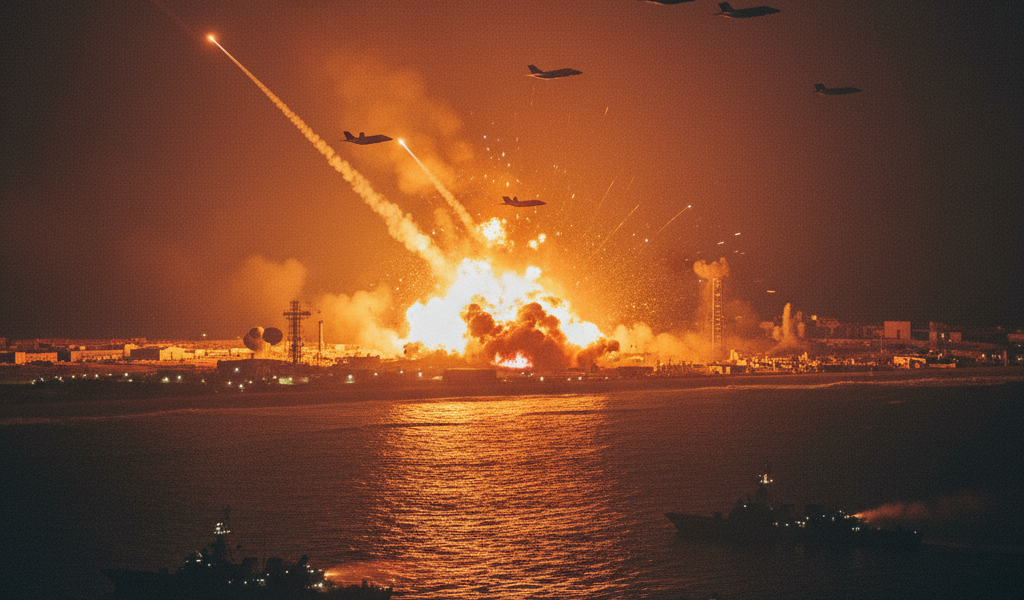
In a decisive demonstration of advanced airpower and unwavering commitment to maritime security, U.S. Air Force F-35 Lightning II stealth fighter jets have executed precision strikes against Houthi missile launch sites and associated infrastructure in Yemen. These targeted operations, conducted under the operational command of U.S. Central Command (CENTCOM), came in direct response to a dangerous escalation of Houthi aggression against international shipping and naval vessels transiting the vital Red Sea and Gulf of Aden waterways. The strikes underscore the F-35’s critical role in projecting power, neutralizing asymmetric threats, and safeguarding global commerce in an increasingly volatile geopolitical landscape.
The kinetic response was triggered by a fresh wave of Houthi attacks that saw anti-ship ballistic missiles (ASBMs) and unmanned aerial vehicles (UAVs) launched indiscriminately at commercial vessels and warships operating in the region. These latest provocations, following months of sustained Houthi assaults, crossed a critical threshold, prompting Washington and its allies to conclude that defensive measures alone were insufficient to deter the Iran-backed militia. The deployment of fifth-generation air assets, specifically the F-35A, signals a significant escalation in the coalition’s approach, moving beyond interdiction to proactive degradation of Houthi offensive capabilities at their source.
**The Escalating Red Sea Crisis and the Imperative for Action**
For months, the Houthis have waged an economic war in the Red Sea, ostensibly in solidarity with Palestinians amid the Israel-Hamas conflict. Their campaign has targeted vessels with tenuous or no connections to Israel, disrupting global shipping lanes that account for approximately 12-15% of global trade. The Bab el-Mandeb Strait, a narrow choke point connecting the Red Sea to the Gulf of Aden and the Indian Ocean, has become a hotbed of maritime insecurity. Shipping companies, facing soaring insurance costs and heightened risk, have increasingly diverted vessels around the Cape of Good Hope, adding weeks to transit times and significantly increasing fuel costs, with ripple effects on global supply chains and inflation.
Operation Prosperity Guardian (OPG), a multinational maritime security initiative launched in December, has seen naval assets from the U.S., UK, and other allied nations actively defending commercial shipping. While OPG forces have successfully intercepted numerous Houthi missiles and drones, preventing catastrophic damage and loss of life, the sheer volume and persistence of the attacks necessitated a more robust and offensive posture. The Houthi strategy has been one of attrition, testing the resolve and resources of the international coalition. Their ability to reconstitute and launch new attacks from mobile sites and concealed locations underscored the need for precision, deep-strike capabilities that could reach into Yemen and dismantle the infrastructure enabling these assaults.
**The Anatomy of the Strikes: F-35 Precision and Strategic Intent**
The recent F-35-led strikes targeted a range of Houthi military facilities, including identified missile storage depots, launch preparation sites, command and control nodes, and radar installations critical for targeting maritime traffic. These sites, often embedded within or near civilian areas, demand an airframe capable of delivering ordnance with extreme accuracy while minimizing collateral damage – a hallmark capability of the F-35 Lightning II.
U.S. Air Force F-35As, operating from established regional airbases, leveraged their unparalleled stealth, sensor fusion, and precision strike capabilities to penetrate contested airspace and neutralize designated targets. The F-35’s ability to operate undetected deep within enemy territory, gather intelligence, and share real-time data with other coalition assets makes it an ideal platform for such complex missions. Utilizing munitions such as Joint Direct Attack Munitions (JDAMs) and Small Diameter Bombs (SDBs), the F-35s delivered surgical strikes designed to degrade the Houthis’ capacity to conduct further attacks. The choice of the F-35 for these missions was not arbitrary; it represents a calculated decision to employ the most advanced, survivable, and precise strike platform in the U.S. inventory, signaling both capability and resolve.
**The F-35 Lightning II: A Cornerstone of Modern Airpower**
The F-35 Lightning II, a fifth-generation multirole fighter, represents the pinnacle of modern air combat technology, designed for air superiority and strike missions in highly contested environments. Its deployment against Houthi targets highlights several key capabilities:
1. **Stealth Technology:** The F-35’s very low observable (VLO) design allows it to penetrate sophisticated air defense networks undetected, significantly enhancing survivability and enabling deep strikes against well-defended targets. While the Houthis possess a relatively unsophisticated air defense network compared to peer adversaries, the F-35’s stealth ensures mission success with minimal risk to aircrew and assets, preserving resources for potential future operations against more advanced threats.
2. **Sensor Fusion:** The F-35 integrates data from multiple on-board sensors – including its Active Electronically Scanned Array (AESA) radar, Electro-Optical Targeting System (EOTS), and Distributed Aperture System (DAS) – into a single, coherent battlespace picture presented to the pilot. This “quarterback of the battlespace” capability provides unprecedented situational awareness, allowing pilots to identify, track, and engage targets with greater confidence and accuracy, even in dynamic threat environments. This was crucial for identifying and discriminating between legitimate military targets and civilian infrastructure in Yemen.
3. **Precision Strike:** Armed with a variety of precision-guided munitions, including JDAMs (GPS-guided bombs) and SDBs (smaller, glide-enabled bombs with enhanced accuracy and lower collateral damage potential), the F-35 can deliver surgical strikes against fixed and mobile targets. The SDB, in particular, allows for multiple targets to be engaged on a single pass, increasing efficiency and reducing exposure time. This precision is paramount when operating in complex terrains where minimizing civilian casualties is a strategic imperative.
4. **Network-Centric Warfare:** The F-35 acts as a node in a vast information network, sharing its fused sensor data with other airborne, ground, and naval assets via secure data links like Link 16 and the Multi-Function Advanced Data Link (MADL). This connectivity enhances overall battlespace awareness for the entire coalition, enabling more coordinated and effective responses. In the Red Sea context, F-35 intelligence could be fed directly to OPG naval units, enhancing their maritime domain awareness and defensive posture.
5. **Survivability:** Beyond stealth, the F-35 incorporates advanced electronic warfare systems, robust countermeasures, and hardened airframe design to enhance its resilience against hostile fire. This combination ensures that even if detected, the F-35 is exceptionally difficult to engage successfully.
**Operational and Budgetary Implications**
The deployment of F-35s in the Red Sea reflects a strategic calculation regarding the operational impact and cost-effectiveness of advanced platforms. While the F-35 has a higher per-hour operating cost than legacy fighters, its unparalleled capabilities often translate into fewer sorties required to achieve desired effects, reduced risk to pilots, and minimized collateral damage. A single F-35 can often accomplish what might require multiple sorties from older aircraft, each carrying a smaller payload and requiring more extensive support packages (e.g., dedicated electronic warfare aircraft, suppression of enemy air defenses).
Furthermore, the F-35’s ability to precisely target and neutralize high-value Houthi assets, such as specific missile launch components or command centers, prevents the need for more extensive and potentially more costly follow-on operations. This precision targeting also reduces the likelihood of unintended escalation by demonstrating a clear intent to degrade specific military capabilities rather than engaging in indiscriminate bombing. The long-term investment in the F-35 program is now paying dividends in real-world contingency operations, validating its design for complex, asymmetric threats in challenging environments.
Compared to adversary systems, the F-35 operates in a league of its own. The Houthis, while equipped with a significant arsenal of Iranian-supplied missiles and drones, possess very limited sophisticated air defense capabilities. Their air defense systems primarily consist of older, Soviet-era surface-to-air missile (SAM) systems and anti-aircraft artillery, which are utterly ineffective against a stealth platform like the F-35. This technological asymmetry allows F-35s to operate with near impunity, ensuring mission success and aircrew safety. Even if the Houthis were to deploy more modern Iranian-supplied radar or SAM systems, the F-35’s stealth and electronic warfare suite are designed to counter such threats, providing a decisive advantage.
**Allied Participation and Regional Dynamics**
While the F-35 strikes were primarily a U.S. Air Force operation, they occurred within a broader framework of allied cooperation. The United Kingdom has been a steadfast partner in both defensive and offensive operations against the Houthis, with Royal Air Force Typhoons participating in previous joint strikes. Other nations contribute significantly to Operation Prosperity Guardian, providing naval escorts and intelligence sharing, even if they do not directly participate in kinetic strikes. This multinational approach lends legitimacy and burden-sharing to the efforts, demonstrating a unified international front against Houthi aggression.
The Houthis’ actions are deeply intertwined with the ongoing Yemeni civil war and Iran’s broader regional proxy strategy. Tehran has consistently supplied the Houthis with advanced weaponry, training, and intelligence, enabling their sophisticated attacks. These Red Sea operations serve multiple Iranian objectives: demonstrating solidarity with Hamas, exerting pressure on the U.S. and its allies, and showcasing their ability to disrupt global trade via proxies. The U.S. and coalition response aims not only to deter the Houthis but also to send a clear message to Iran about the unacceptable consequences of destabilizing regional security.
However, the precision strikes also carry inherent risks. While intended to de-escalate by degrading Houthi capabilities, they could also provoke further retaliation, potentially widening the conflict. Regional actors like Saudi Arabia and the UAE, who have previously been targets of Houthi attacks, watch these developments closely. The stability of the entire Arabian Peninsula hinges on the ability of the international community to contain the Houthi threat without triggering a larger regional conflagration.
**Historical Context of Houthi Aggression**
The Houthi movement, officially Ansar Allah, emerged in the 1990s as a Zaydi Shia revivalist group in northern Yemen. Their conflict with the Yemeni government escalated into a full-blown civil war in 2014, with the Houthis seizing the capital, Sana’a. Saudi Arabia and its allies intervened in 2015 to restore the internationally recognized government, leading to a protracted and devastating conflict. Throughout this period, the Houthis have consistently employed ballistic missiles and drones against Saudi and Emirati targets, demonstrating a willingness to project power beyond their immediate borders.
Their pivot to targeting Red Sea shipping in late 2023 marked a significant escalation. While they had previously harassed shipping, their newfound capability to strike commercial vessels with advanced anti-ship missiles (some derived from Iranian designs like the “Ghadr” or “Qader” series) and long-range UAVs transformed them into a formidable maritime threat. This evolution underscores the continuous transfer of sophisticated weaponry and expertise from Iran, enabling a non-state actor to imperil a critical global maritime artery. The F-35 strikes are a direct counter to this evolving threat profile, aiming to roll back their advanced capabilities and re-establish deterrence.
**Implications for U.S. National Security and Global Military Posture**
The F-35 Lightning II strikes against Houthi missile infrastructure in Yemen carry profound implications for U.S. national security and the global military posture. Firstly, they reaffirm the U.S. commitment to freedom of navigation and the protection of international commerce, vital tenets of the rules-based international order. The Red Sea is not merely a regional waterway; it is a global artery whose disruption has immediate and far-reaching economic consequences for the United States and its allies. Failure to act decisively would embolden other malign actors to challenge maritime security elsewhere, setting a dangerous precedent.
Secondly, the deployment and successful execution of these missions by F-35s underscore the enduring relevance and necessity of investing in advanced, fifth-generation airpower. In an era characterized by resurgent great power competition and the proliferation of sophisticated weaponry to non-state actors, platforms like the F-35 provide the U.S. military with an unmatched capability to project power, deter aggression, and respond surgically to threats across the spectrum of conflict. The F-35’s ability to operate effectively against both near-peer adversaries and asymmetric threats like the Houthis demonstrates its versatility and strategic value. It ensures that the U.S. maintains a qualitative military edge, allowing it to dictate terms in contested environments and protect its interests globally.
Thirdly, these strikes serve as a critical component of the broader U.S. strategy to counter Iranian regional destabilization efforts. By degrading the offensive capabilities of an Iranian proxy, the U.S. is directly challenging Tehran’s ability to exert influence through coercive means. This sends a clear message that the costs of enabling such aggression will be borne by its proxies, and potentially, by Iran itself. The precision and measured nature of the F-35 strikes also reflect an attempt to balance deterrence with de-escalation, aiming to restore stability without triggering an uncontrollable regional conflagration.
Finally, the operations highlight the imperative for sustained allied cooperation and burden-sharing. While the U.S. possesses unparalleled military capabilities, the complexity and global reach of modern threats necessitate a networked response. The multinational effort in the Red Sea, encompassing defensive maritime operations and targeted offensive strikes, exemplifies the strength of alliances in upholding international security. The F-35’s interoperability and data-sharing capabilities further enhance this coalition effectiveness, integrating seamlessly with allied forces and amplifying their collective power. The ongoing Red Sea crisis is a stark reminder that U.S. national security is inextricably linked to global stability, and the F-35 Lightning II remains a potent instrument in safeguarding both.
More From Breaking News
 Breaking News
Strategic Convergence: USS Boxer ARG Deployment Signals Heightened Posture in Persian Gulf Littoral, Kharg Island Eyed
 Breaking News
Spearhead of the Pacific: Marine Littoral Regiments Forge Island Defense Prowess with Philippine Allies
 Breaking News
Navigating the Crucible: General Votel's Strategic Imperatives for the Strait of Hormuz
 Breaking News