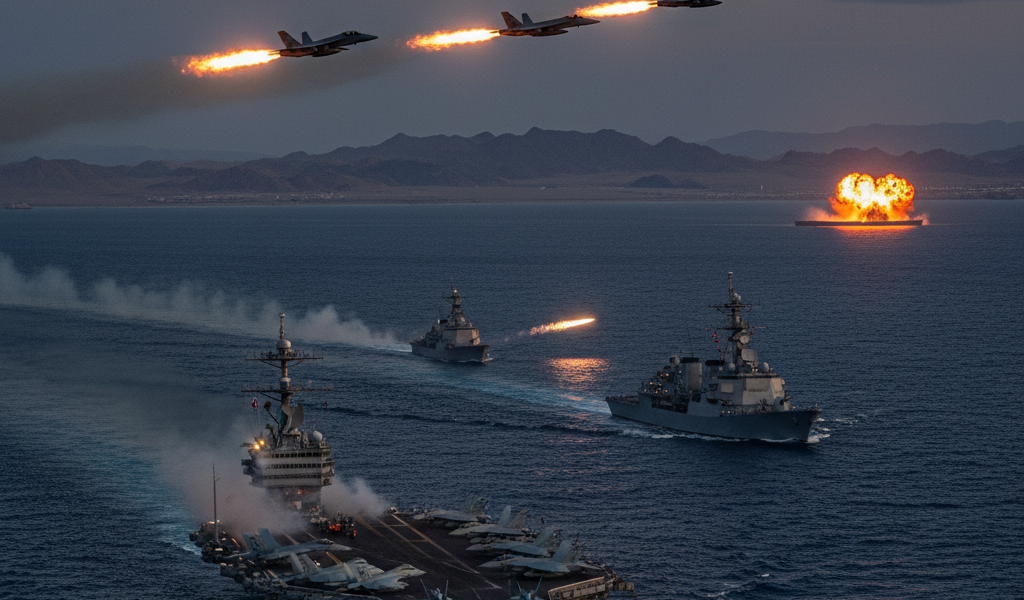
The Strait of Hormuz, a narrow maritime artery connecting the Persian Gulf to the Arabian Sea, stands as one of the world’s most critical and volatile geopolitical chokepoints. Its strategic importance is unparalleled, serving as the transit route for a substantial portion of the globe’s crude oil and liquefied natural gas (LNG) shipments, alongside a myriad of other vital goods. Any disruption to this flow carries immediate and far-reaching economic ramifications, capable of destabilizing global energy markets and triggering widespread economic crises. The notion that securing or “opening” this vital passage could be achieved through a “simple maneuver” fundamentally misunderstands the profound operational complexities, the formidable military challenges, and the immense geopolitical risks inherent in any such endeavor. This assessment delves into the intricate layers of military strategy, historical precedent, and technological capabilities that underscore the gravity of operations within this maritime crucible.
Geographically, the Strait of Hormuz is a maritime bottleneck, barely 21 nautical miles wide at its narrowest point, with the navigable shipping lanes reduced to just two miles in each direction, separated by a two-mile buffer zone. These lanes are constrained by shallow waters and numerous islands, making transit inherently challenging even under peaceful conditions. To the north lies the coastline of Iran, a nation with a declared intent and demonstrated capability to contest passage; to the south, the Musandam Peninsula, part of Oman, and the United Arab Emirates. This confined geography is crucial to understanding the operational calculus. It amplifies the effectiveness of anti-access/area denial (A2/AD) strategies, making large-scale naval maneuvers difficult and increasing the vulnerability of transiting vessels and naval assets alike. The entire maritime domain within and surrounding the Strait is thus a theater ripe for conflict, where even minor incidents can escalate rapidly into major confrontations.
The historical tapestry of the Strait of Hormuz is interwoven with episodes of tension and conflict, providing a stark reminder of its enduring volatility. The most significant precedent is the “Tanker War” of the 1980s, a phase of the Iran-Iraq War where both belligerents targeted merchant shipping in an attempt to cripple each other’s economies. This period saw extensive mine warfare, missile attacks, and naval skirmishes that severely disrupted global energy flows. The United States, under Operation Earnest Will, deployed naval forces to protect reflagged Kuwaiti tankers, directly intervening to safeguard freedom of navigation. This culminated in Operation Praying Mantis in April 1988, a decisive U.S. Navy response to Iranian mine-laying that resulted in the largest surface-to-surface naval battle since World War II. During this operation, U.S. forces engaged and neutralized several Iranian naval vessels and oil platforms, demonstrating the overwhelming conventional superiority of the U.S. Navy but also highlighting the willingness of regional actors to employ asymmetric tactics. These historical events underscore that any intervention in Hormuz is not merely a theoretical exercise but a return to a historically contested battlespace with deeply entrenched strategic interests.
Iran’s military doctrine, particularly that of the Islamic Revolutionary Guard Corps Navy (IRGCN), is explicitly tailored to exploit the unique geography of the Strait of Hormuz through asymmetric warfare. Recognizing its limitations against a technologically superior conventional adversary, Iran has invested heavily in capabilities designed to inflict disproportionate damage, deny access, and deter intervention. Central to this strategy is mine warfare. Iran possesses a diverse and extensive inventory of naval mines, including moored, bottom, and limpet mines, some of which are sophisticated influence mines. These can be deployed rapidly and clandestinely by a variety of platforms: conventional surface vessels, fishing boats, small dhows, submarines, and even coastal installations. Mine clearance is a notoriously slow, dangerous, and resource-intensive operation, requiring specialized mine countermeasures (MCM) vessels, remotely operated vehicles (ROVs), unmanned underwater vehicles (UUVs), and highly trained explosive ordnance disposal (EOD) teams. Even a small number of mines can effectively close a shipping lane for days or weeks, creating immense economic pressure and operational delay.
Beyond mines, Iran’s asymmetric toolkit includes a vast fleet of fast attack craft (FACs) and fast inshore attack craft (FIACs), often armed with anti-ship missiles (ASMs), torpedoes, or heavy machine guns. These small, agile vessels are designed for “swarm” tactics, overwhelming larger, less maneuverable warships through sheer numbers and coordinated attacks in the confined littoral environment. The IRGCN also operates a growing arsenal of shore-based and vessel-mounted anti-ship cruise missiles, capable of targeting vessels throughout the Strait and well into the Persian Gulf. These missiles, including variants of the C-802 (Nour) and other indigenously developed systems, pose a significant threat to surface combatants and merchant shipping alike. Furthermore, Iran has developed and deployed an array of unmanned aerial vehicles (UAVs) and unmanned surface vessels (USVs) for intelligence, surveillance, and reconnaissance (ISR) and, increasingly, for offensive roles, including kamikaze attacks or targeting data for other platforms. Its submarine fleet, comprising Kilo-class conventional submarines and numerous midget submarines, adds a subsurface dimension to its A2/AD capabilities, posing a threat to both surface and subsurface assets. Coastal artillery, anti-ship ballistic missiles, and advanced air defense systems further complicate any ingress or sustained operation.
For the United States and its allies, securing the Strait of Hormuz against such a multi-faceted threat is an operation of immense complexity and scale. It is crucial to distinguish between “opening” a blocked strait and “securing” it for sustained, safe passage. “Opening” might involve a rapid, decisive strike to clear an immediate obstruction, but “securing” entails maintaining freedom of navigation over an extended period in a contested environment, which is a far more demanding and resource-intensive undertaking.
A comprehensive operation to secure the Strait would necessitate a multi-domain approach, leveraging the full spectrum of U.S. military capabilities. Air superiority would be paramount, requiring sustained combat air patrols from carrier strike groups (CSGs) and land-based air assets to suppress Iranian air defenses, neutralize coastal missile batteries, and protect naval forces and merchant shipping from air and missile threats. This would involve significant Suppression of Enemy Air Defenses (SEAD) operations, a complex undertaking against modern, integrated air defense networks.
Surface warfare assets, including guided-missile destroyers (DDGs) and cruisers (CGs), would be tasked with providing air defense for the battle group and merchant convoys, engaging Iranian surface combatants, and conducting maritime interdiction operations. The presence of littoral combat ships (LCS), designed for operations in coastal waters, could be valuable for countering fast attack craft and conducting specialized missions, though their survivability in a high-intensity A2/AD environment remains a subject of debate.
The most challenging aspect would undoubtedly be mine countermeasures. A single minefield could require multiple MCM vessels, operating in hazardous conditions, supported by helicopters like the MH-53E Sea Dragon, and numerous unmanned systems. The process is slow, meticulous, and vulnerable to attack. Clearing a single shipping lane could take weeks, and the risk of re-mining would be constant, necessitating continuous MCM operations. EOD teams would also be crucial for clearing unexploded ordnance and neutralizing specific threats.
Subsurface warfare capabilities, including attack submarines (SSNs), would be essential for countering Iranian submarines, conducting reconnaissance, and potentially targeting coastal installations. Their stealth and endurance would provide a critical advantage in the contested waters. Special Operations Forces (SOF) would likely play a vital role, conducting clandestine reconnaissance, targeting specific high-value Iranian assets, and potentially conducting direct action raids on coastal missile sites or mine-laying vessels.
Logistics for such an operation would be staggering. Sustaining a large naval presence, continuous air operations, and extensive MCM efforts in a forward-deployed environment would strain supply lines, fuel reserves, and maintenance capabilities. Resupply convoys would themselves become targets, necessitating additional protection. Furthermore, the rules of engagement (ROE) would be a delicate balancing act, requiring clear guidelines for when and how to engage Iranian forces to deter aggression without inadvertently escalating to a wider regional conflict. De-escalation pathways would need to be constantly sought and maintained, even amidst active hostilities.
The legal and diplomatic dimensions add another layer of complexity. International law, specifically the United Nations Convention on the Law of the Sea (UNCLOS), guarantees the right of “transit passage” through straits used for international navigation. Iran, while a signatory to UNCLOS, has not fully ratified it and has historically asserted its right to control passage through the Strait, particularly for military vessels, demanding prior notification. Any Iranian attempt to physically close the Strait or impose a de facto blockade would be a clear violation of international law and a direct threat to global commerce, constituting a potential casus belli for international intervention. However, the legal justification for offensive operations, the scope of such operations, and the involvement of international partners would be subject to intense scrutiny and debate on the global stage.
The economic and geopolitical repercussions of any significant military operation in the Strait of Hormuz would be immediate and severe. A sustained closure or even significant disruption would send crude oil prices soaring, potentially to unprecedented levels, triggering a global recession. Supply chains across industries would be disrupted, and insurance premiums for maritime shipping would skyrocket, effectively choking international trade. Regionally, the conflict would likely destabilize already fragile alliances, potentially drawing in other Gulf states and proxy actors, leading to a wider conflagration. The humanitarian cost, both in terms of military casualties and civilian impact, could be immense. The long-term strategic implications could include a permanent shift in global energy routes, accelerated investments in alternative energy sources, and a re-evaluation of maritime security doctrines worldwide.
In conclusion, the Strait of Hormuz is far from a simplistic operational environment. It is a complex, high-stakes geopolitical crucible where the interplay of geography, history, military doctrine, and economic imperatives creates an exceptionally challenging theater of operations. Any military intervention, whether to “open” or “secure” the Strait, would entail a multi-domain, resource-intensive endeavor fraught with significant risks, demanding meticulous planning, robust force projection, and a clear understanding of the potential for rapid escalation. The notion of a “simple maneuver” fails to grasp the formidable asymmetric capabilities developed by Iran, the inherent difficulties of mine countermeasures in a contested environment, the immense logistical requirements, and the catastrophic economic and geopolitical implications of a protracted conflict. The enduring challenge for global maritime security, and indeed for global stability, lies in preventing such a scenario through robust deterrence, strategic patience, and unwavering commitment to freedom of navigation, while always being prepared for the grim realities of conflict in this vital chokepoint.
More From Breaking News
 Breaking News
Ground Engagement in Iran: A Deep Dive into Tactical Realities and Strategic Peril
 Breaking News
Tehran's Alleged Overtures: A Diplomatic Flashpoint Amidst Denials and Escalating Regional Tensions
 Breaking News
F-35 Lightning IIs Decimate Houthi Missile Infrastructure in Red Sea Retaliation Strikes
 Breaking News