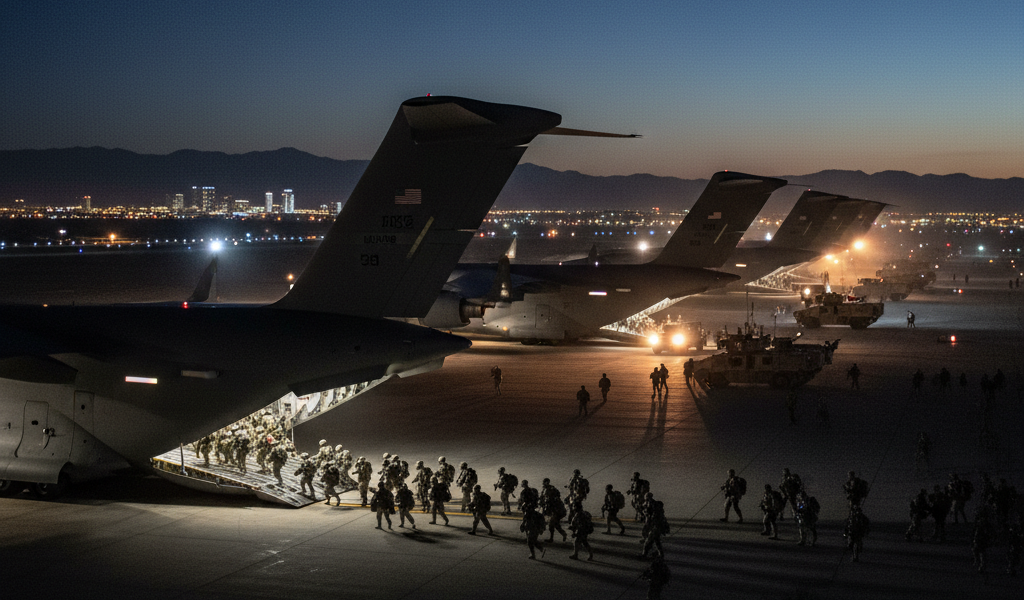
The United States Department of Defense has confirmed the deployment of elements from the venerable 82nd Airborne Division to the Middle East, a strategic maneuver undertaken as Washington recalibrates its force posture in a region increasingly fraught with tension. This decisive commitment of a premier rapid-deployment force signals a clear message of resolve and readiness at a critical juncture, underscoring the enduring American commitment to stability and the protection of its interests and personnel in a volatile geopolitical landscape. The deployment arrives amidst a significant escalation of regional hostilities, primarily driven by the expanding footprint and influence of state and non-state actors aligned with Iran, necessitating a robust and adaptable military response.
The 82nd Airborne Division, headquartered at Fort Liberty, North Carolina, stands as the U.S. Army’s quintessential rapid-response light infantry formation. Known globally as “America’s Guard of Honor,” the division embodies the nation’s capacity for immediate strategic projection. Its paratroopers are uniquely trained and equipped for forced-entry operations, capable of deploying anywhere in the world within 18 hours to conduct a full spectrum of combat and contingency missions. The selection of the 82nd for this deployment is therefore not merely a logistical choice but a profound strategic statement. It signifies the Pentagon’s assessment that the situation demands a unit capable of rapid insertion, sustained combat operations in diverse environments, and serving as a credible deterrent against further aggression.
Historically, the 82nd Airborne has been at the vanguard of numerous U.S. military interventions and humanitarian missions, a testament to its unparalleled readiness and versatility. From the battlefields of World War II, where its paratroopers famously jumped into Normandy and the Netherlands, to its pivotal role in Operation Urgent Fury in Grenada, Operation Just Cause in Panama, and later, its deployments during Operations Desert Shield and Desert Storm, the division has consistently demonstrated its capacity to respond with speed and lethality. Its extensive experience in the Middle East includes significant deployments during Operation Iraqi Freedom and Operation Enduring Freedom, where its brigades conducted complex counterinsurgency and stability operations across Iraq and Afghanistan. This deep institutional knowledge of the regional operational environment, combined with its inherent agility, makes the 82nd a uniquely suited instrument for addressing the current complexities.
The specific “elements” deploying typically refer to a Brigade Combat Team (BCT), or a substantial portion thereof, augmented by critical enabling assets. An airborne BCT is a self-contained fighting force, comprising three infantry battalions, a cavalry squadron, an artillery battalion, a brigade support battalion, and a brigade engineer battalion. This structure provides a potent mix of direct combat power, reconnaissance, fires support, logistics, and engineering capabilities. While light in comparison to armored or Stryker BCTs, the airborne brigade’s strength lies in its ability to deploy rapidly by air, often jumping directly into an area of operations or conducting airland operations to establish a foothold. Its equipment, optimized for air transport, includes M4 carbines, M240 machine guns, Javelin anti-tank missile systems, Stinger man-portable air-defense systems, and a range of light tactical vehicles such as the Joint Light Tactical Vehicle (JLTV) and Humvees. The inherent mobility and distributed lethality of these forces are critical in environments where rapid changes in threat posture or mission requirements are common.
The current regional backdrop against which this deployment unfolds is characterized by a dangerous and accelerating cycle of actions and reactions. Iran, through its Islamic Revolutionary Guard Corps (IRGC) and a network of proxy militias, has aggressively sought to expand its influence across the Levant, Iraq, and Yemen. This strategy manifests in various forms, including ballistic missile and unmanned aerial system (UAS) attacks against U.S. personnel and allied interests, harassment of international shipping in critical waterways like the Strait of Hormuz and the Red Sea, and the destabilization of sovereign states through paramilitary operations. Recent weeks have witnessed a pronounced uptick in these activities, necessitating a robust and visible demonstration of American military power to deter further aggression, protect U.S. forces and assets, and reassure regional partners.
The decision to deploy the 82nd Airborne is part of a broader re-evaluation of U.S. force posture in the Central Command (CENTCOM) area of responsibility. Over the past several years, U.S. strategy has sought to reduce large-scale ground footprints in the region, shifting focus towards “over-the-horizon” counter-terrorism operations and prioritizing strategic competition with peer adversaries. However, the persistent and escalating threat from Iranian-backed groups has compelled a reassessment, highlighting the continued necessity for a credible in-theater presence capable of immediate response. This deployment effectively augments existing U.S. naval, air, and ground forces, creating a more layered and resilient defense architecture. It also serves as a critical component of the Immediate Response Force (IRF) framework, ensuring that the U.S. military maintains the capacity to rapidly project power and respond to unforeseen contingencies, from large-scale combat operations to non-combatant evacuation operations (NEO) or humanitarian assistance and disaster relief (HADR) missions.
From a doctrinal perspective, the deployment of airborne forces to a theater of operations typically serves multiple objectives. Firstly, it enhances force protection for existing U.S. military installations and personnel. The presence of highly trained light infantry, capable of conducting security operations, patrols, and rapid reaction missions, significantly complicates an adversary’s ability to conduct attacks. Secondly, it provides additional crisis response capabilities. Should a U.S. embassy or consulate come under threat, or if a rapid evacuation of American citizens becomes necessary, the 82nd’s elements are uniquely poised to execute such sensitive missions. Thirdly, and perhaps most importantly, it functions as a potent deterrent. The very presence of an elite, combat-proven unit known for its aggressive posture sends an unambiguous signal to potential adversaries that any further escalation will be met with a swift and decisive response. It raises the “cost-benefit” calculus for those contemplating hostile actions, emphasizing that the U.S. possesses not only the will but also the immediate capability to defend its interests.
The logistical undertaking of deploying an airborne brigade is a monumental effort, showcasing the unparalleled strategic airlift capabilities of the U.S. Air Force and the seamless joint interoperability of the armed services. Large-body transport aircraft, primarily C-17 Globemaster IIIs and potentially C-130 Hercules, are instrumental in moving thousands of personnel, their individual combat loads, and hundreds of vehicles and specialized equipment across vast distances. This complex ballet of air mobility requires meticulous planning, coordination, and execution, from marshalling points at Fort Liberty to forward operating bases in the Middle East. Sustainment of these forces once deployed also presents a continuous logistical challenge, requiring robust supply lines for ammunition, fuel, rations, medical supplies, and maintenance parts. However, the U.S. military has honed these capabilities over decades of global deployments, ensuring that the 82nd can remain fully mission-capable for extended periods.
Beyond the immediate tactical and operational considerations, the deployment carries significant strategic implications. For allies in the region, it reaffirms the credibility of U.S. security guarantees and signals a continued commitment to regional stability. Nations that have long relied on the American security umbrella, particularly those facing direct threats from Iranian proxies, will view this move as a tangible demonstration of support. Conversely, for adversaries, it complicates their strategic calculus, forcing them to reconsider the potential repercussions of further provocative actions. The U.S. posture in the Middle East is not merely about projecting power but about shaping the regional security environment in a manner conducive to American interests and international norms.
Examining this deployment through a historical lens reveals a recurring pattern in U.S. foreign policy: the strategic use of military presence as a tool of diplomacy and deterrence. During the Cold War, the deployment of U.S. forces to Europe and Asia served to contain Soviet and Chinese expansionism. In the post-9/11 era, the presence of U.S. forces in the Middle East was central to counter-terrorism efforts and nation-building initiatives. While the specific threats and objectives evolve, the underlying principle of leveraging military power to achieve strategic aims remains constant. The current deployment of the 82nd Airborne reflects an adaptation of this principle to address a resurgent and aggressive state actor, demonstrating the U.S.’s ability to pivot and recalibrate its military instruments in response to evolving global challenges.
Defense strategists and analysts of regional security dynamics note that while the deployment of a rapid-response force is a necessary step, it must be integrated into a broader diplomatic and economic strategy. Military deterrence, while crucial, is most effective when coupled with robust diplomatic engagement, intelligence sharing, and targeted economic sanctions designed to alter an adversary’s behavior. The current situation demands a multi-faceted approach that not only deters immediate aggression but also seeks to de-escalate tensions and foster long-term stability without inadvertently provoking a wider conflict. The presence of the 82nd Airborne provides the United States with greater leverage and flexibility in pursuing these objectives, creating a stronger foundation from which to negotiate or, if necessary, to respond.
The decision to deploy elements of the 82nd Airborne Division to the Middle East is a clear and unambiguous signal of U.S. resolve and readiness in the face of escalating regional instability. This move underscores the enduring importance of rapid-deployment forces in contemporary global security, providing the United States with a critical tool to deter aggression, protect its interests, and reassure allies. As the geopolitical landscape in the Middle East continues to shift, the presence of these elite paratroopers reinforces the American commitment to maintaining a robust and adaptable military posture, capable of responding swiftly and decisively to any challenge. The implications are profound, signaling to both allies and adversaries that the United States is prepared to take concrete steps to safeguard its strategic objectives and ensure the security of its personnel and partners in a vital and volatile region.
More From Breaking News
 Breaking News
Ground Engagement in Iran: A Deep Dive into Tactical Realities and Strategic Peril
 Breaking News
A Nation Remembers: Senior Leadership Reaffirms Enduring Honor for Vietnam Veterans at Hallowed Memorial
 Breaking News
Strategic Convergence: USS Boxer ARG Deployment Signals Heightened Posture in Persian Gulf Littoral, Kharg Island Eyed
 Breaking News