
The strategic landscape of the Persian Gulf region remains a crucible of geopolitical tension, with recent movements of U.S. military assets signaling an unequivocal shift towards heightened readiness. In an environment already fraught with a complex web of proxy conflicts, maritime incidents, and nuclear proliferation concerns, the contemplation of sustained ground operations within Iran represents a profound escalation in contingency planning. This development underscores a significant recalibration of U.S. strategic calculus, moving beyond conventional air and naval deterrence to encompass the complex and demanding requirements of a potential land-based intervention that could endure for weeks.
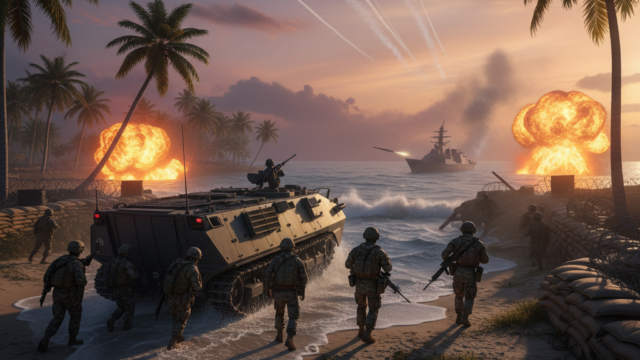
The ongoing “flood” of U.S. military assets into the U.S. Central Command (CENTCOM) area of responsibility is not merely a show of force but a deliberate and methodical build-up designed to provide a comprehensive range of response options. At the forefront of this deployment is the USS Tripoli Amphibious Ready Group (ARG) and its embarked 31st Marine Expeditionary Unit (MEU). The ARG-MEU construct is a cornerstone of naval power projection, representing a formidable, self-contained air-ground-logistics task force capable of executing a diverse array of missions, from humanitarian assistance and disaster relief to large-scale combat operations, including forcible entry.
The USS Tripoli, an America-class amphibious assault ship, serves as the flagship, effectively functioning as a small aircraft carrier for the ARG’s aviation combat element, primarily F-35B Lightning II Joint Strike Fighters and various rotary-wing assets. These fifth-generation stealth fighters provide critical air superiority, close air support, and intelligence, surveillance, and reconnaissance (ISR) capabilities, essential for any ground operation. Complementing the Tripoli are other amphibious ships, typically a Landing Platform Dock (LPD) and a Landing Ship Dock (LSD), which carry the bulk of the MEU’s ground combat element, including tanks, armored personnel carriers, artillery, and logistical support vehicles, along with a robust complement of landing craft air cushion (LCACs) and utility landing craft (LCUs) for ship-to-shore movement.
The 31st MEU itself is a highly adaptable and lethal force, comprising roughly 2,200 Marines and Sailors. It is structured around four core elements: a Command Element (CE) for planning and control, a Ground Combat Element (GCE) built around an infantry battalion reinforced with tanks, artillery, and combat engineers, an Aviation Combat Element (ACE) with a mix of fixed-wing and rotary-wing aircraft, and a Logistics Combat Element (LCE) providing critical support functions such as medical, maintenance, and supply. This inherent versatility makes the MEU particularly suited for rapid response and operations across the full spectrum of conflict. Their presence signals a readiness not just for limited strikes, but for sustained engagement that could involve seizing and holding terrain, securing critical infrastructure, or conducting complex raids deep within hostile territory.
Beyond the ARG-MEU, the broader reinforcement of CENTCOM includes the deployment of additional carrier strike groups (CSGs), each centered around a Nimitz- or Ford-class aircraft carrier and its complement of strike fighters, early warning aircraft, and escort ships equipped with advanced missile defense systems. These CSGs provide unparalleled air power and a robust defensive shield. Furthermore, bomber task force (BTF) deployments of B-1B Lancers, B-52 Stratofortresses, and B-2 Spirits to regional airbases offer long-range precision strike capabilities, while advanced fighter squadrons, Patriot missile defense batteries, and specialized ISR platforms have also been strategically positioned. This layered approach ensures air superiority, defends critical assets, and provides comprehensive situational awareness across the vast operational area. The logistical infrastructure to sustain such a large-scale deployment, including forward operating bases (FOBs), prepositioned equipment, and robust supply lines, is also being continually enhanced, indicative of preparations for potentially prolonged engagements.
The notion of “weeks of ground operations” within Iran is a phrase loaded with significant implications, diverging sharply from past U.S. military engagements in the region that have primarily relied on air power, special operations forces, or limited punitive strikes. It suggests an operational objective far more ambitious and enduring than mere deterrence or retaliation. Such an undertaking would necessitate a substantial commitment of personnel and resources, far exceeding the scale of typical special operations raids or surgical strikes. It implies a requirement for sustained presence, the establishment of secure perimeters, and potentially, direct confrontation with elements of the Iranian military and its proxies over an extended period.
The potential objectives of such operations could range from securing critical choke points like the Strait of Hormuz, neutralizing specific weapon systems or facilities, to disrupting command and control networks, or even supporting internal resistance movements, though the latter carries immense risks of mission creep and unintended consequences. Unlike fleeting aerial bombardments, ground operations inherently involve direct and continuous contact with enemy forces, greater exposure to casualties, and the complex challenges of operating in diverse and often hostile terrain. The duration implied – “weeks” – further suggests that initial objectives might be followed by phases of consolidation, stabilization, or counter-insurgency, rather than a swift, decisive withdrawal. This level of commitment would transform the nature of any conflict from a limited engagement into a full-scale intervention, with all the attendant strategic, logistical, and human costs.
To understand the profound implications of contemplating sustained ground operations in Iran, it is essential to draw upon historical context and lessons learned from past conflicts in the region. The U.S. experience in Iraq, particularly the 2003 invasion, offers a salient, albeit imperfect, parallel. While the initial “shock and awe” campaign swiftly dismantled Saddam Hussein’s conventional forces and led to the collapse of his regime, the subsequent occupation and counter-insurgency operations dragged on for years, incurring immense human and financial costs. Key lessons included the challenges of urban warfare, the difficulties of nation-building, the resilience of an insurgency, and the immense logistical tail required to sustain a large ground force in a hostile environment. The U.S. military, while possessing unparalleled technological superiority, found itself mired in a conflict that blurred lines between conventional combat and asymmetric warfare, highlighting the importance of clear political objectives and robust exit strategies – elements that would be exponentially more complex in the context of Iran.
The 1991 Gulf War, by contrast, demonstrated the capacity for a swift and decisive ground campaign, but under vastly different geopolitical circumstances. A clear mandate, a broad international coalition, and a conventional Iraqi army arrayed in open desert terrain allowed for a rapid maneuver warfare campaign. Iran, however, presents a far more complex challenge. Its terrain is rugged and mountainous, its population centers dense, and its military doctrine heavily reliant on asymmetric tactics, including a vast network of tunnels, missile sites, and proxy forces.
Perhaps the most relevant historical context for understanding the Iranian military psyche and capabilities comes from the Iran-Iraq War (1980-1988). This brutal eight-year conflict, fought largely on Iranian soil, forged a highly resilient and ideologically driven military. Iran demonstrated a willingness to absorb immense casualties, employ human wave attacks, and utilize innovative, albeit often rudimentary, tactics to defend its territory. The Islamic Revolutionary Guard Corps (IRGC), in particular, emerged from this conflict as a powerful and ideologically committed force, distinct from the conventional Artesh (regular army), and now forms the backbone of Iran’s asymmetric warfare capabilities and regional proxy network. The war instilled a deep-seated suspicion of foreign intervention and a fierce determination to resist any perceived invasion, lessons that remain deeply ingrained in Iran’s strategic culture.
From a military perspective, Iran’s defense strategy is a layered approach designed to deter and, if necessary, counter a superior adversary. Its conventional forces, while numerically large, possess aging equipment, much of it pre-dating the 1979 revolution or acquired from limited sources due to international sanctions. However, the sheer volume of personnel, combined with a significant investment in indigenous arms production, particularly in ballistic and cruise missiles, drones, and naval assets, presents a formidable challenge. Iran’s missile arsenal is one of the largest in the Middle East, capable of striking targets across the region, including U.S. bases and allied capitals. Its drone program has also matured rapidly, providing both ISR and strike capabilities that have been effectively utilized by its proxies.
The IRGC’s naval component, operating primarily in the Strait of Hormuz and the Persian Gulf, employs a doctrine of asymmetric warfare, utilizing swarms of fast attack craft, anti-ship missiles, and naval mines to threaten maritime traffic and deny access to larger, conventional navies. The Quds Force, the IRGC’s extraterritorial special operations arm, is responsible for cultivating and supporting a vast network of proxy groups across the Middle East, including Hezbollah in Lebanon, various Shiite militias in Iraq, and the Houthis in Yemen. These proxies provide Iran with significant levers of influence and the ability to project power and conduct retaliatory actions without direct attribution, complicating any U.S. response.
Furthermore, Iran’s cyber warfare capabilities are increasingly sophisticated, posing a threat to critical infrastructure, military networks, and economic systems. Any ground operation would inevitably be accompanied by a robust cyber front, targeting both military and civilian assets. The rugged and diverse Iranian terrain, characterized by vast mountain ranges, deserts, and densely populated urban centers, would present immense operational challenges for any invading force. Conventional maneuver warfare would be difficult, and urban combat would likely result in high casualties and collateral damage. Iran’s strategic depth and the potential for a prolonged, attritional conflict are factors that military planners must meticulously consider. The ultimate wild card remains Iran’s nuclear program. Any large-scale intervention could potentially push Iran to accelerate its nuclear ambitions, or even deploy a weapon as a deterrent, fundamentally altering the strategic calculus.
The challenges and risks for U.S. forces in undertaking prolonged ground operations in Iran are manifold and profound. Logistically, sustaining a large ground force over “weeks” in the CENTCOM area of responsibility would be an immense undertaking. Supply lines would be stretched, requiring constant air and sea protection, and the sheer volume of fuel, ammunition, spare parts, and provisions would strain resources. Medical support for potentially high casualty rates would also be a critical concern. Politically, such an intervention would likely lead to widespread regional destabilization, inflaming anti-American sentiment, empowering extremist groups, and potentially drawing other regional and global powers into the conflict. Global energy markets would be severely disrupted, with cascading economic consequences worldwide.
The risk of mission creep, where initial, limited objectives expand into broader, more ambiguous goals, is ever-present in complex interventions. Defining a clear end-state and an achievable exit strategy would be paramount, yet incredibly difficult in the fluid and unpredictable environment of a ground conflict in Iran. The potential for significant U.S. casualties, especially in urban or mountainous terrain, could erode domestic support and generate immense political pressure. Moreover, Iran’s asymmetric response capabilities mean that any U.S. ground operation would likely trigger retaliatory actions against U.S. allies, shipping in the Gulf, or even U.S. interests globally through its proxy network or cyber attacks. The intricate web of alliances and rivalries in the Middle East means that a conflict with Iran could easily spill over, drawing in other nations and creating a wider regional conflagration.
The implications of the U.S. military actively preparing for “weeks of ground operations” in Iran are far-reaching and signal a dramatic shift in strategic posture. This level of contingency planning suggests that all other avenues of deterrence or limited engagement are either deemed insufficient or have failed to achieve desired outcomes in a escalating crisis scenario. It reflects a sober assessment of the potential for large-scale conflict and a commitment to ensuring that the U.S. military possesses the capabilities and readiness to execute such complex and demanding operations. While planning does not equate to inevitability, the scale and duration implied by “weeks of ground operations” underscore the gravity of the current geopolitical environment in the Persian Gulf and the potential for a transformative military engagement that would reverberate across the globe. The focus now shifts to the critical balance between deterrence and the very real preparations for intervention, a balance that will define the trajectory of regional security for years to come.
More From Breaking News
 Breaking News
Spearhead of the Pacific: Marine Littoral Regiments Forge Island Defense Prowess with Philippine Allies
 Breaking News
Transatlantic Defense Media Expands European Footprint Amidst Resurgent Geopolitical Tensions
 Breaking News
Iranian Proxy Attack on Prince Sultan Air Base Underscores Enduring Threat to US Forces in the Middle East
 Breaking News