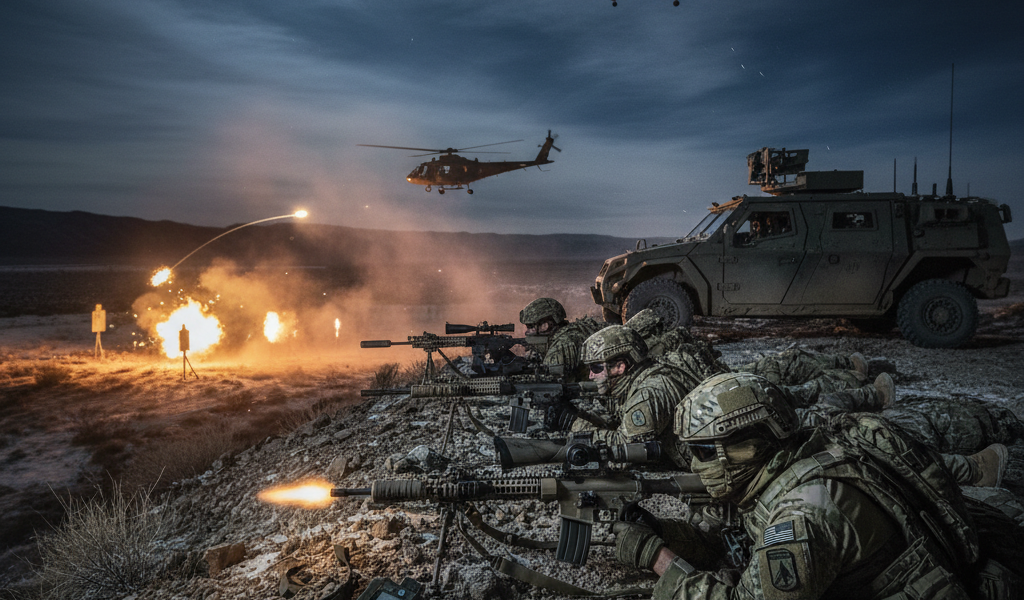
Fort Bragg, North Carolina – In a testament to unparalleled skill, rigorous training, and unwavering mental fortitude, the U.S. Army Special Operations Command (USASOC) has once again asserted its dominance, securing the coveted top prize at the annual international sniper competition hosted on these hallowed grounds. Seventeen elite sniper teams, representing the pinnacle of marksmanship and fieldcraft from across all U.S. military services and several partner nations, converged to test the limits of their capabilities in a grueling, multi-faceted crucible designed to identify the absolute best. USASOC’s victory is not merely a win in a competitive event; it is a profound affirmation of their advanced doctrine, their relentless pursuit of perfection, and the critical role their specialized snipers play in the intricate tapestry of modern global operations.
The annual sniper competition at Fort Bragg is far more than a simple shooting match. It is an exhaustive, multi-day gauntlet that meticulously evaluates every facet of a sniper team’s operational readiness. Competitors are pushed to their physical and mental breaking points, navigating complex scenarios that demand not only pinpoint accuracy but also superior fieldcraft, tactical intelligence, and seamless teamwork. Events range from extreme long-range engagements, where environmental factors like wind, mirage, and even the Earth’s rotation (Coriolis effect) must be meticulously calculated, to close-quarters battle (CQB) scenarios requiring rapid target acquisition and precision under duress. Teams are challenged with physically demanding movements over varied terrain, often carrying full combat loads, before immediately transitioning into high-stress firing positions. They must execute complex land navigation tasks, establish clandestine observation posts, and perform detailed target identification and reporting, simulating the critical intelligence, surveillance, and reconnaissance (ISR) role of a modern sniper.
One of the most iconic and demanding aspects of such competitions is the “stalk” event, where teams must infiltrate an area, set up a firing position, engage a target, and exfiltrate, all while remaining undetected by dedicated spotters using advanced optics. This event, more than any other, highlights the art of concealment, camouflage, and movement, embodying the very essence of the sniper’s craft. Other challenges include stress shoots, where snipers must engage multiple targets after intense physical exertion, and intelligence-gathering exercises that test their ability to observe, interpret, and report critical battlefield information under time constraints. Ammunition management, target discrimination, and the ability to adapt to unexpected scenarios are also rigorously assessed, ensuring that only the most comprehensive and adaptable teams emerge victorious. The demanding nature of this competition underscores that an elite sniper is not just an expert marksman, but a highly trained, multi-skilled special operations asset.
The historical lineage of the sniper is long and storied, evolving from isolated sharpshooters to integral components of modern combat operations. While rudimentary forms of precision marksmanship existed for centuries, the true emergence of the military sniper as a specialized role began to take shape during the American Revolutionary War. Figures like Timothy Murphy, known for his incredible shot at the Battle of Saratoga, demonstrated the psychological and tactical impact of precise, long-range fire. The American Civil War saw further development, with both Union and Confederate forces employing designated marksmen. However, it was during World War I, amidst the static trench warfare, that the sniper truly became a formidable and feared presence. Figures like the German “ghost snipers” and their Allied counterparts honed the skills of concealment, observation, and precision interdiction, often engaging high-value targets such as enemy officers, artillery spotters, and machine-gun crews.
The role further solidified in World War II, with legendary figures like Simo Häyhä, the “White Death” from Finland, and Vasily Zaytsev of the Soviet Union, who famously dueled with German snipers in Stalingrad. These individuals, operating often with rudimentary scopes or even iron sights in extreme conditions, showcased the devastating potential of a well-placed shot. Post-WWII, the U.S. military, particularly during the Vietnam War, saw the rise of iconic snipers such as Marine Corps Gunnery Sergeant Carlos Hathcock, whose legendary exploits cemented the sniper’s modern image as a highly skilled, patient, and lethal force multiplier. Hathcock’s record-setting shots and innovative tactics, including the use of specialized ammunition and improvised suppressors, significantly influenced subsequent sniper doctrine.
In contemporary warfare, the sniper’s role has expanded far beyond mere target interdiction. Today’s elite snipers are integral to reconnaissance and surveillance, providing critical ISR to commanders. They can establish clandestine observation posts, gather intelligence on enemy movements and dispositions, and identify high-value targets (HVTs) or high-payoff targets (HPTs) for kinetic or non-kinetic engagement. In urban environments, snipers provide crucial overwatch for maneuver elements, identifying threats, clearing routes, and protecting friendly forces from elevated positions. Their ability to deliver precision fires with minimal collateral damage makes them invaluable in complex operational environments, particularly in counter-insurgency and counter-terrorism operations where civilian casualties must be meticulously avoided. Furthermore, snipers serve as a psychological deterrent, their unseen presence creating a pervasive sense of vulnerability among enemy forces, degrading morale and operational tempo.
USASOC’s consistent excellence in these competitions is no accident; it is a direct reflection of their rigorous selection processes, advanced training methodologies, and a doctrine that emphasizes adaptability and comprehensive soldiering. Special Operations Forces (SOF) snipers, whether from Army Special Forces, Rangers, or other specialized units, undergo an arduous training pipeline. This journey begins long before they ever attend a dedicated sniper school. Candidates are typically seasoned operators with extensive combat experience, demonstrating exceptional physical fitness, mental resilience, and a deep understanding of small-unit tactics. Their selection is often predicated on their ability to operate autonomously or as part of small, highly effective teams, often in austere and politically sensitive environments.
Once selected, USASOC snipers attend specialized courses that delve deep into advanced marksmanship, ballistics, wind reading, range estimation, and target engagement techniques across varied distances and environmental conditions. Beyond the purely technical aspects of shooting, the training heavily emphasizes fieldcraft: camouflage and concealment, movement techniques, establishing and operating from hide sites, and advanced land navigation. They are trained not just to shoot accurately, but to become masters of their environment, capable of operating undetected for extended periods. Furthermore, SOF snipers receive extensive training in intelligence gathering, reporting procedures, and the integration of their observations into the broader operational picture. They are often cross-trained in other critical skills, such as advanced communications, combat medicine, and even foreign languages, enabling them to operate effectively across the full spectrum of special operations missions. The symbiotic relationship between the shooter and the spotter is a cornerstone of this training, with both individuals needing to possess a deep understanding of each other’s roles, communicating seamlessly to deliver precision effects.
The presence of seventeen teams, representing various branches of the U.S. military—Army, Marine Corps, Navy, Air Force, and National Guard—alongside elite units from partner nations, elevates the competition beyond mere bragging rights. It serves as a vital proving ground and a crucible for exchanging tactics, techniques, and procedures (TTPs). The concept of “iron sharpens iron” is profoundly evident here. Each team brings its unique doctrinal approach and operational experiences, fostering an environment of competitive learning. U.S. Marine Corps Scout Snipers, renowned for their aggressive reconnaissance and precision fire support, operate with a distinct philosophy compared to, say, a U.S. Army Special Forces sniper, who might emphasize deep infiltration and sustained observation. The competition allows these disparate approaches to be tested against a common, challenging standard, leading to innovation and refinement across the board.
International participation is equally crucial. Allied nations often field their most elite sniper assets, from units akin to the British SAS or German KSK, bringing diverse perspectives and operational methods. This interoperability is paramount in an era of coalition warfare, where U.S. forces frequently operate alongside international partners. Shared understanding of capabilities, limitations, and best practices forged in these competitive environments translates directly into enhanced effectiveness and cohesion on the battlefield. It builds trust, strengthens alliances, and ensures that, when called upon, these highly specialized units can integrate seamlessly to achieve common objectives.
The skillset of an elite sniper extends far beyond the ability to pull a trigger accurately. It encompasses a complex interplay of scientific understanding, physical endurance, and profound mental discipline. A master of ballistics, the sniper must account for atmospheric pressure, temperature, humidity, and the Coriolis effect, which subtly alters a bullet’s trajectory over extreme distances. Windage and elevation adjustments are calculated with meticulous precision, often using advanced ballistic calculators, but always underpinned by an intuitive understanding honed through countless hours of training. Mirages, heat shimmer, and other environmental phenomena that distort targets must be read and interpreted with expert acumen.
Physically, snipers must possess exceptional strength and stamina. Carrying heavy precision rifle systems, optics, ammunition, and survival gear over long distances, often through arduous terrain, is standard. The ability to maintain a rock-steady firing position after hours of movement or exertion is a testament to their physical conditioning. Mentally, the demands are even greater. Patience is a cardinal virtue; a sniper might spend days in a hide site, observing, waiting for the opportune moment. Decision-making under extreme pressure, ethical considerations regarding rules of engagement, and the ability to maintain focus amidst stress and fatigue are critical. They must process vast amounts of information, filter out distractions, and make split-second decisions that can have strategic consequences. The ability to remain calm, disciplined, and utterly focused is what separates the merely good from the truly elite.
Modern sniper training regimens are incredibly sophisticated, leveraging both traditional fieldcraft and cutting-edge technology. Initial entry-level sniper schools, such as the U.S. Army Sniper School at Fort Benning (now Fort Moore), provide a foundational understanding of precision marksmanship and fieldcraft. However, for special operations snipers, this is merely the beginning. Advanced courses delve into specialized topics like counter-sniper tactics, urban sniping, maritime operations, and high-altitude marksmanship. Continuous unit-level training ensures that skills remain sharp and that teams are proficient with the latest equipment and TTPs. Simulation technologies, including virtual reality and advanced firing range systems, allow snipers to practice complex scenarios without expending costly live ammunition, providing immediate feedback and allowing for rapid skill development.
Technological advancements have profoundly impacted the sniper’s craft. Precision rifle systems, often chambered in calibers like .308 Winchester, .300 Winchester Magnum, .338 Lapua Magnum, or even .50 BMG, are engineered for extreme accuracy. Advanced optics featuring variable magnification, illuminated reticles, and integrated ballistic solutions provide unparalleled clarity and targeting capabilities. Laser rangefinders offer instantaneous and precise distance measurements, while environmental sensors provide real-time data on wind, temperature, and humidity. Suppressed weapon systems reduce muzzle flash and sound signature, enhancing stealth and preserving the sniper’s position. Precision-manufactured ammunition, with tighter tolerances and improved ballistic coefficients, ensures consistent performance. However, these technological aids are only as effective as the sniper wielding them; they augment, rather than replace, fundamental skills and human judgment.
The consistent success of USASOC in these elite competitions carries significant implications for the broader U.S. military and its allies. It validates their training doctrine, their investment in specialized personnel, and their operational methodologies. When a unit consistently outperforms its peers in such a rigorous test, it signals that their approach to selection, training, and deployment of snipers is highly effective and perhaps worthy of emulation. This can lead to the cross-pollination of TTPs, with other conventional and special operations units studying USASOC’s methods to enhance their own sniper programs. It also reinforces the importance of maintaining and continually investing in these specialized capabilities, particularly as the geopolitical landscape shifts towards potential peer-on-peer conflicts and multi-domain operations. The precision, discretion, and strategic impact of a well-employed sniper team will remain a critical asset in future conflicts, from denying enemy freedom of movement to providing critical intelligence in contested environments.
In conclusion, USASOC’s victory at the international sniper competition is a powerful affirmation of the command’s relentless pursuit of excellence and the critical role of its precision marksmen in global security. This event not only showcases the zenith of individual skill and teamwork but also serves as a vital platform for inter-service and international collaboration, fostering innovation and enhancing readiness across the board. The modern sniper, a master of both science and art, continues to evolve, adapting to new threats and technologies, yet remaining steadfast in the core tenets of precision, patience, and lethal effectiveness. As the nature of warfare continues its inexorable transformation, the specialized capabilities demonstrated by these elite snipers will remain an indispensable component of any nation’s defense posture, ensuring that the U.S. military and its allies retain a decisive edge in the complex operational environments of tomorrow.
More From Breaking News
 Breaking News
Beyond the 'Simple Maneuver': The Geopolitical Crucible of the Strait of Hormuz
 Breaking News
The Evolving Shadow: DNI Gabbard's Threat Assessment Details Resurgent Islamist Terror Networks
 Breaking News
A Nation Remembers: Senior Leadership Reaffirms Enduring Honor for Vietnam Veterans at Hallowed Memorial
 Breaking News