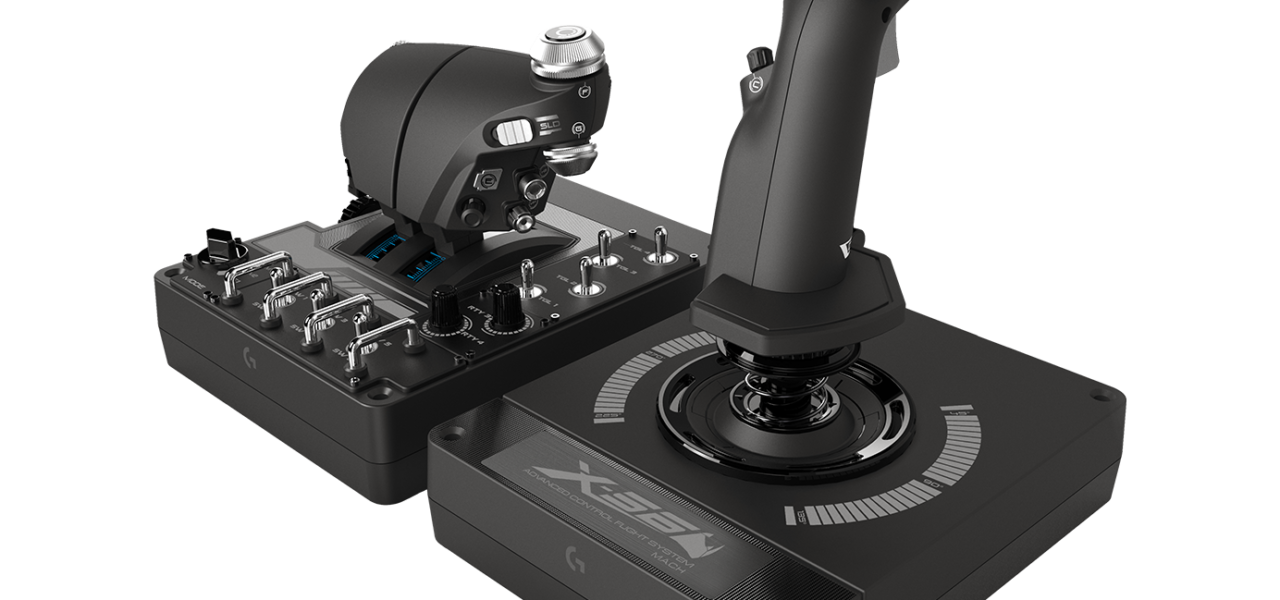
As seasoned pilots on americanairframe.com, we’re always on the hunt for flight simulation hardware that delivers both performance and value. The Logitech X56 Rhino HOTAS (Hands On Throttle And Stick) has long occupied a fascinating space in the market: positioned above entry-level offerings but below the premium, often eye-wateringly expensive, enthusiast gear. At its current price of $249, it promises an abundance of controls and customization. But does it truly deliver the precision and durability required for the unforgiving skies of military flight simulation? I’ve put the X56 through its paces across countless hours and demanding scenarios to bring you this definitive review.
The Logitech X56 is a beast of a HOTAS when it comes to sheer input potential. Its design philosophy clearly prioritizes giving the pilot as many programmable buttons, hats, and axes as possible. The stick features a robust array of buttons, including multiple hat switches, a trigger, and a pinky button, all easily accessible. What truly sets the X56 apart, however, is its throttle unit. This dual-throttle design, which can be locked together for single-engine aircraft or split for twin-engine jets, is adorned with an impressive selection of rotary dials, toggle switches, and additional hat switches. Each component is also backlit with customizable RGB lighting, adding a touch of modern flair to your cockpit setup and aiding visibility in low-light conditions. Through Logitech’s G HUB software, every single input can be meticulously programmed, layered, and assigned, making it a truly versatile tool for complex aircraft systems.
Build quality is often a point of contention with mid-range peripherals, and the X56 is no exception. The unit is predominantly constructed from high-quality plastics, which keeps the weight down but might not inspire the same confidence as an all-metal build. That said, the plastics feel solid, and the fit and finish are generally good. The stick features an interchangeable spring system, allowing pilots to adjust the resistance to their preference, a thoughtful touch. The throttle, while functionally excellent with its numerous inputs, does suffer from a somewhat lighter detent feel than some might prefer, and the initial movement can sometimes feel a little stiff before settling into a smoother glide. Both units are weighted adequately and feature strong suction cups for desktop use, though for serious simmers, mounting to a dedicated cockpit rig or desk mounts is highly recommended for maximum stability and immersion. My unit has held up well to rigorous use, showing that while it may not be constructed from aerospace-grade aluminum, it’s certainly not flimsy.
Where the Logitech X56 truly needs to shine is in the cockpit of military flight simulators, and here, it largely delivers. In the demanding environment of DCS World, the X56 proves its worth. For modules like the F-16C Viper, the stick’s precise pitch and roll control, combined with the readily available trim and weapon release buttons, make for intuitive dogfighting and bombing runs. The dual throttle is invaluable for the F/A-18C Hornet, allowing for precise power management during carrier landings and tactical maneuvers. Its numerous hats and rotaries easily map to radar modes, targeting pods, and countermeasures, replicating the Hornet’s complex control scheme effectively. The A-10C Warthog, with its bewildering array of switches and systems, finds a natural partner in the X56’s throttle unit, where nearly every button and dial can be assigned to a specific function, minimizing the need for keyboard input. Even for a classic like the F-14 Tomcat, the X56 adapts well; while a genuine “grip” is different, the sheer number of available inputs allows for comprehensive control of flight surfaces, weapon systems, and even some RIO functions if you’re flying solo. The precision of the stick’s axes allows for nuanced adjustments during air-to-air refueling or formation flying.
Moving beyond dedicated combat sims, the X56 also performs admirably in more general flight simulators. In Microsoft Flight Simulator, the smooth throttle control allows for accurate power settings, crucial for everything from bush planes to airliners, and the stick provides responsive control for various aircraft types, including the growing number of military aircraft add-ons. X-Plane 12 benefits similarly from the X56’s detailed input capabilities, providing a solid foundation for realistic flight dynamics and complex systems management across its diverse fleet. The sheer number of programmable inputs means you can tailor your setup to virtually any aircraft, ensuring that your hands rarely leave the controls.
Pros:
* An unrivaled number of programmable buttons, hats, and axes for the price.
* Dual throttle design offers versatility for single and multi-engine aircraft.
* Customizable RGB lighting and interchangeable stick springs.
* Excellent precision for stick axes, crucial for demanding maneuvers.
* Highly customizable via Logitech G HUB software.
* Great value for simmers needing more than basic controls.
Cons:
* Predominantly plastic construction may not appeal to all.
* Throttle detents can feel somewhat light, and initial movement can be stiff.
* Some users report occasional ghosting or stick drift issues (though less common in newer revisions).
* G HUB software, while powerful, can sometimes be a bit finicky.
Verdict:
The Logitech X56 HOTAS is a compelling option for military flight simmers who are ready to step up from entry-level gear but aren’t quite ready to commit to the ultra-premium market. It’s a workhorse, designed to provide an abundance of controls to tackle the most complex modules in DCS World, MSFS, and X-Plane. While its build quality is good rather than exceptional, its functionality, precision, and sheer number of inputs make it an incredibly versatile and capable piece of hardware. If you fly complex aircraft like the F-16, F/A-18, A-10C, or F-14 and crave dedicated control over every system without breaking the bank, the X56 is an excellent choice that will serve you well in countless virtual sorties. It’s a significant upgrade that genuinely enhances immersion and control for the dedicated pilot.
